FHA loan on a mobile home: Requirements and how to apply
Contributed by Karen Idelson
Updated Nov 1, 2026
•10-minute read

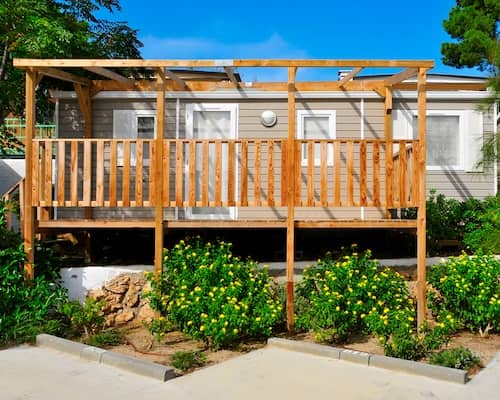
You can get an FHA loan on a mobile home if it’s built on or after June 15, 1976.1 These are referred to as manufactured homes. A mobile home built before that date usually doesn’t qualify, but knowing what lenders look for up front helps.
Here’s what to know about FHA Title I and Title II loans, home and borrower requirements, and how to apply.
Key takeaways:
- A HUD label is evidence that the manufactured home is eligible for FHA financing based on being constructed on or after June 15, 1976, and meeting federal guidelines.
- Title I can finance a home alone or a home on a leased lot. Title II covers a home and land bought together. Rocket Mortgage offers Title II loans.
- An FHA loan from Rocket Mortgage requires a credit score of at least 580 and that you use the home as your primary residence.2
What qualifies as a mobile or manufactured home?
To get an FHA loan on a mobile home, the property has to be an eligible manufactured home. That means a factory-built home that meets the Department of Housing and Urban Development (HUD)’s Manufactured Home Construction and Safety Standards.
Mobile vs. manufactured vs. modular homes
People often use “mobile home” for anything that comes off the line on wheels, but federal regulations draw clear lines between 3 types:
- Mobile home: This is a factory-built home constructed before June 15, 1976.
- Manufactured home: This is a factory-built home built to HUD’s standards on or after June 15, 1976.
- Modular home: A modular home is built in sections at a factory. When it’s assembled on site, it’s treated under the same local construction codes and lending guidelines as stick-built homes.
HUD labels, data plate, and construction date
There are 2 things you’ll find on a compliant manufactured home that will let you know it’s eligible for regular mortgage financing:
- HUD certification label: Also called a HUD tag, this metal plate is attached to the exterior of each transportable section. A double-wide has two.
- HUD data plate: This paper label lists the manufacturer, the year built, and the serial number. You’ll often find it near the electrical panel, on a kitchen cabinet door, or in a bedroom closet.
The home also needs the data plate and has to show a construction date of June 15, 1976, or later. If a label or plate is damaged or illegible, a letter from the Institute for Building Technology and Safety (IBTS) can be ordered.
A home built before June 15, 1976, falls outside HUD’s construction standards, so FHA financing to buy it generally isn’t available.
See what you qualify for
FHA Title I vs. Title II manufactured home loans
Two FHA programs cover manufactured homes in different situations. FHA-approved lenders make both types of FHA loans. Rocket Mortgage offers Title II loans.
Here’s how the programs compare:
|
Feature |
Title I |
Title II |
|
What it finances |
The home or lot alone, or the home and a lot |
The home and the land together |
|
Land |
Owned or leased |
Owned, or held through a recorded leasehold |
|
Property classification |
Personal property or real estate |
Real property |
|
Foundation |
Must meet HUD installation standards and state and local requirements |
Permanent foundation that meets HUD guidelines |
|
Offered by Rocket Mortgage |
No |
Yes |
FHA Title I loans
Title I loans can finance the home, the lot, or both. They apply when the home is classified as personal property, or when you lease the land. You may hear these referred to as chattel loans.
Title I loans carry nationwide limits that depend on the financing arrangement. For a manufactured home and lot, the limit is up to $237,096 for a multi-section home and $148,909 for a single-section home. You can also get up to $43,377 to buy and develop a lot for a manufactured home.
Title I also includes a separate Property Improvement Loan program. These loans fund repairs and upgrades to a manufactured home, including one built before June 15, 1976, but they aren’t meant for buying the home.
Rocket Mortgage doesn’t offer FHA Title I loans.
FHA Title II loans
Title II applies when you own or are buying the manufactured home and the land together as permanent real estate. You can’t pay lot rent. It’s purchased and taxed as real property. If you’re planning to buy a manufactured home and land in one purchase, this is the program to look at.
Rocket Mortgage offers FHA loans for manufactured homes under Title II.
Financing a home in a mobile home park
Title I may apply if your home sits on a leased lot, such as a site in a mobile home park or manufactured home community. To protect the investment of both the FHA and homeowners, the following rules apply:
- Initial term: The lease must run at least 3 years.
- Advance notice: The lease must require at least 180 days’ written notice if it’s ending.
These protections give you time to plan if the owner sells the land or closes the park. Again, Rocket Mortgage doesn’t offer Title I loans.
Take the first step toward the right mortgage
Apply online for expert recommendations with real interest rates and payments
FHA manufactured home requirements
Most items apply to every FHA manufactured home loan, and a few apply to Title II only. The home also needs to meet FHA minimum property standards, which an appraiser reviews.
Construction and size requirements
- HUD standards: The home must be built to federal construction and safety standards, with a HUD tag on each section.
- Minimum size: The home needs at least 400 square feet of living area.
- Towing hitch and running gear: For Title II, the hitch, wheels, and axles must be removed once the home is placed.
Foundation, land, and real property requirements
For a Title II loan, the home and land need to count as one piece of permanent real estate. Real property is land and everything permanently attached to it, while personal property is movable.
- Permanent foundation: The home must be anchored to a permanent foundation that meets HUD’s Permanent Foundations Guide for Manufactured Housing. A licensed engineer or architect certifies it. This is checked every time unless it’s an FHA Streamline loan.3
- Real property status: Under Title II, the home must convert from personal property to real property. This usually means local authorities register and tax it as real estate. Any vehicle title is surrendered.
- Land ownership: You own the land or hold a recorded leasehold.
- Home history: The home must have been occupied only on its current site rather than moved from elsewhere.
Site access and utility requirements
The site needs safe, year-round road access. If the home isn’t on a public street, the street must be community-maintained or privately maintained, with a legally enforceable agreement covering access and upkeep. The home also needs connected and inspected water lines.
FHA borrower eligibility requirements
Rules around the home are one thing, but what about the requirements for clients?
Credit score and down payment
FHA loans let you put down as little as 3.5% with a credit score of at least 580. With a score from 500 to 579, the minimum down payment is 10%.
Rocket Mortgage requires a credit score of at least 580 to qualify. Lenders can set higher minimums than FHA does, so credit score requirements vary from one lender to the next.
Credit scores below 580 are often associated with subprime loans, which means higher rates and down payment requirements. Rocket Mortgage would rather work with you to bring your credit up to get better loan terms for affordability.
DTI ratio and mortgage insurance
Lenders consider your debt-to-income ratio (DTI), which is your total monthly debt payments divided by your gross monthly income. Different loan products and lenders set different DTI limits.
FHA financing also requires mortgage insurance premiums (MIP). You’ll pay an upfront premium of 1.75% of the base loan amount, plus an annual premium that’s added to your monthly payment. The annual amount depends on your loan amount, loan term, and down payment or equity.
Occupancy, income, and CAIVRS requirements
- Occupancy: The home must be used as a primary residence. That means moving in within 60 days of closing.
- Stable, documented income: Lenders typically look for a 2-year work history, backed by documentation.
- CAIVRS check: The Credit Alert Verification Reporting System (CAIVRS) is a HUD database lenders use to check for federal debt in default, such as a delinquent student loan, or an insurance claim HUD paid in the past 3 years. These typically need to be resolved before moving forward.
How to get an FHA loan for a mobile home
The steps follow the standard FHA loan process, with a few extra property checks along the way.
Choose the right FHA loan option
Start by matching your situation to a loan type. Here’s how each one looks in practice:
- Home only (Title I): You already own a lot and want financing for the home itself, without rolling the land into the loan.
- Home on a leased lot (Title I): You’re buying a home in a manufactured home community and paying lot rent to the park owner.
- Lot purchase (Title I): You’re looking to buy the land the home is going to sit on separately from the home itself.
- Home and land together (Title II): You’re buying the home and the land under it in one purchase. This is the option Rocket Mortgage offers.
Prepare the property documents
Checking out the following can help avoid surprises:
- Construction date and HUD labels: Confirm the data plate shows June 15, 1976, or later, and check for a certification label on each section.
- Foundation: Make sure you can get a foundation certification from a licensed engineer or architect.
- Land or lease: Have your land ownership records or lease agreement ready.
- Site access and utilities: Confirm road access and approved water and sewer connections.
Apply through an FHA-approved lender
FHA insures loans on behalf of approved lenders rather than making the loans itself. Lenders have their own requirements. Rocket Mortgage is an FHA-approved lender.
Getting preapproved for an FHA loan can help set a ceiling on your budget. It can also help you make a competitive offer once you find a home.
Pros and cons of an FHA loan on a mobile home
Every loan comes with trade-offs. For a wider look, see our guide to FHA loan pros and cons.
Pros
- Lower down payment options: With a credit score of at least 580, you may qualify for a 3.5% down payment.
- Lower credit score options: FHA guidelines work with credit scores as low as 500, though a lower score means a larger down payment.
- Potential DTI flexibility: FHA guidelines allow lenders to consider higher DTI ratios when the rest of your application is strong. You may qualify with a DTI as high as 57% if you have strong compensating factors like a high credit score or sufficient residual income.
Cons
- Mortgage insurance: You’ll pay both an upfront and an annual premium, which adds to your total cost. The annual premium is included in your monthly payment. If you have a down payment of 10% or more, it lasts 11 years. Otherwise, it’s for the life of the loan.
- Borrowing limits: Title I loans have nationwide caps, and Title II loans follow standard FHA loan limits for your area.
- Strict property rules: The construction date, foundation certification, and real property status all have to check out, which can take time.
Alternatives to FHA manufactured home loans
FHA loans have some very specific rules. If you don’t qualify, other mobile home loans may fit better depending on your situation.
Conventional, VA, and USDA loans
Conventional, VA, and USDA loans may also finance a manufactured home, depending on you and the property.4 Each program sets its own rules for home type, land, and eligibility. Comparing FHA vs. conventional loans is a good place to start. Rocket Mortgage doesn’t offer USDA loans at this time.
Chattel loans
A chattel loan finances a manufactured home as personal property instead of real estate. It may be an option when the home sits on land you don’t own or can’t be converted to real property.
Chattel loans often come from nonmortgage lenders. They may come with higher interest rates because the land isn’t included. Much of the value of the home is in the land itself. Without the real estate, the home can lose value over time due to wear and tear.
FAQ
Here are answers to a few more common questions.
What disqualifies you from an FHA loan?
Either property or borrower requirements could bar you from getting an FHA loan:
- A construction date before June 15, 1976, or a home without HUD labels.
- Property issues, such as a foundation that can’t be certified or a home that can’t convert to real property.
- Plans to use the home as something other than your primary residence.
- A credit score below the lender’s minimum.
- Income you can’t document.
- A CAIVRS finding, such as federal debt in default.
How much do I need to make to buy a $300K house with an FHA loan?
There’s no single income requirement. Qualifying depends on your documented income, DTI, monthly housing expenses, other debts, and the lender’s review. For a closer look at how much house you can afford, check our guide to FHA affordability, or run your own numbers with our home affordability calculator.
An example can help you picture it. Freddie Mac’s weekly survey put the average 30-year fixed rate at 7.40% as of Oct. 8, 2026. Let’s say you’re buying a $300,000 home with 3.5% down at that rate, and you have $800 in other monthly debts. The principal and interest payment on the $289,500 loan is $2,004.44.*
If we use a 36% DTI ratio as a benchmark for affordable housing costs, you’d need a gross monthly income of $7,790.11. That comes to $93,481.32 per year. Please note that this example doesn’t include property taxes and homeowners insurance.
Can I take out more than one FHA manufactured home loan?
FHA loans are meant for primary residences, so you can generally have only one at a time. There are exceptions where you may have more than one FHA-backed manufactured home:
- Job relocation: You’re moving for work to a new location that’s too far to go back and forth from your current home. Distance requirements apply.
- Larger family: You’ve outgrown your current space. You have to have documented proof of this and 25% equity in your current home.
- Leaving a jointly owned home: You’re moving out of a home you own with someone else.
- Non-occupying co-borrower: You’re a co-borrower on someone else’s FHA loan, but you don’t live in that home.
The bottom line: FHA loans can be used for manufactured homes
An FHA loan on a mobile home is possible. The home has to be an eligible manufactured home built on or after June 15, 1976, with HUD labels, a permanent foundation, and a title permanently tied to the land for Title II. You’ll also need a qualifying credit score, stable income, federal debts in good standing, and plans to use it as your primary residence.
Rocket Mortgage offers FHA manufactured home loans under Title II and requires a credit score of at least 580. If you’re ready to get started, you can apply online.
* Any figures, interest rates, loan examples, and market data referenced in this article are hypothetical or aggregated for educational purposes only. They are not intended to reflect current pricing, available terms, or personalized loan options for any consumer. This content does not constitute an advertisement of credit terms, a solicitation or offer to extend credit, or a rate quote under federal or state lending laws. Actual mortgage rates and terms are determined by individual financial qualifications, property characteristics, market conditions, and other factors, and are subject to change without notice. If you are seeking current, real-time mortgage rate information please refer to the official live rate information and product details published at RocketMortgage.com/mortgage-rates, where current pricing and various loan terms are made available.
1 Rocket Mortgage is not acting on behalf of FHA or HUD.
2 To qualify for this offer, you must meet all standard FHA eligibility requirements. In addition, your total mortgage payment, including taxes and insurance, cannot exceed 38% of your income, your debt-to-income (DTI) ratio cannot exceed 45%, and you must have 12 months of verifiable housing history immediately prior to your application, no late payments 30 days or greater in the last 12-months, and no derogatory marks on your credit report. Not available on jumbo loans. Asset statements may be needed, no more than 1 day of non-sufficient fund fees are allowed in the most recent 2 months prior to application. Additional restrictions/conditions may apply.
3 The FHA Streamline program may have stricter requirements in some states. In order to qualify for the FHA Streamline program, an immediate .5% minimum reduction in interest and mortgage insurance premium is required. Some states may require an appraisal.
4 Rocket Mortgage is a VA-approved lender, not endorsed or sponsored by the Dept. of Veterans Affairs or any government agency.
This article is for informational purposes only and is not intended to provide, and should not be relied on for, medical, legal, financial, investment, or tax advice. You should consult with a qualified professional for advice specific to your situation. Consumers should independently verify that any services, products, or programs referenced meet their needs and comply with applicable requirements.
Rocket Mortgage is a trademark or service mark of Rocket Mortgage LLC or its affiliates.

Kevin Graham
Kevin Graham is a senior staff writer for Rocket. He specializes in mortgage qualification, economics and personal finance topics. Kevin has passed the MLO SAFE exam given to mortgage bankers and takes continuing education courses. As someone with cerebral palsy spastic quadriplegia that requires the use of a wheelchair, he also takes on articles around modifying your home for physical challenges and smart home tech. He has a BA in Journalism from Oakland University.
Related resources

13-minute read
How to finance manufactured and mobile home loans
Mobile home loans can work differently than traditional mortgages. Read on to see your financing options, requirements, and how to qualify.
Read more

9-minute read
Manufactured home loans: What buyers should know
Learn how manufactured home loans work, including FHA, VA, conventional, and chattel options, key requirements, and costs. Compare paths and apply today.
Read more

7-minute read
Is the cost of a mobile home worth it? Pros and cons
Wondering about the pros and cons of a mobile home? Our guide explores whether the low cost is worth its disadvantages in comparison to traditional homes.
Read more