Florida property tax guide for homeowners
Contributed by Tom McLean
Feb 4, 2026
•5-minute read

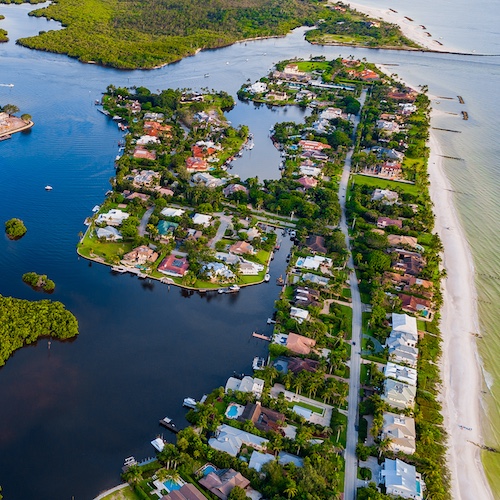
Owning a home in the Sunshine State opens the door to endless possibilities – sandy shores, sunny skies, and so much more. But the Florida property tax system can be complicated, and it's important to understand your home-related costs before you buy a property.
Florida’s property taxes are based on the assessed value of your home, and they vary by county and municipality. These taxes fund critical services like public schools, road maintenance, emergency response, and other essential local programs.
Read on to explore Florida’s property tax rates, exemptions, and tips for managing your tax costs.
How much are property taxes in Florida?
Let's start by aligning on a critical term: the effective tax rate is the percentage of a property's assessed value you pay in annual taxes. The Florida effective tax rate is 0.74%, which the Tax Foundation reports is the 30th-highest among the 50 states in 2023.
Using this rate, let’s calculate the tax for a $411,700 home – roughly the state’s median home price, according to Redfin.
$411,700 x 0.74% = $3,047
$3,047 / 12 months = $254 per month
Note that this figure could change, as there’s a proposed 2026 ballot amendment that would eliminate property taxes on homestead properties in the state.
Compared to nearby states, Florida’s property taxes are higher than Alabama's (0.36%) and South Carolina's (0.47%), and lower than Georgia's (0.77%).
How do Florida property taxes vary by region?
As in most states, property tax rates differ by locality – from 0.45% in Walton County to 1.05% in Hardee County, according to the Tax Foundation – and they also fluctuate year to year.
Below are Florida’s top 10 counties by population, along with their 2023 effective tax rates, median home values, and median property taxes, according to the Tax Foundation.
| County | Effective tax rate | Median home value | Median taxes paid |
|---|---|---|---|
| Miami-Dade | 0.83% | $425,400 | $3,516 |
| Broward | 0.95% | $380.400 | $3,610 |
| Hillsborough | 0.84% | $333,300 | $2,787 |
| Palm Beach | 0.88% | $407,300 | $3,600 |
| Orange | 0.88% | $358,300 | $2,795 |
| Duval | 0.78% | $274,900 | $2,142 |
| Pinellas | 0.73% | $319,000 | $2,324 |
| Lee | 0.83% | $326,300 | $2,699 |
| Polk | 0.74% | $240,000 | $1,769 |
| Brevard | 0.70% | $304,400 | $2,139 |
How are Florida property taxes calculated?
The Florida Department of Revenue calculates tax rates by dividing a property's taxable value by 1,000, then multiplying the result by the county’s millage rate. (A mill equals $1 in taxes for every $1,000 in taxable home value.) Each county sets its millage rates each September, and they can change year to year.
It’s important to understand the difference between your property’s assessed value, which is the market value minus any assessment limits, and its taxable value, which is the assessed value after exemptions are applied.
Note that the county property appraiser typically assesses the market value of a Florida home by January of each year, and you can contest a tax increase by a county-specific deadline. You can find tools to calculate your property tax bill on several state sites, including the official page of the Florida Department of Revenue.
See what you qualify for
Property tax exemptions in Florida
Does Florida have property tax exemptions and relief programs? Yes. These programs can help homeowners reduce or defer their property tax bills. The programs include:
- Homestead exemption. The homestead exemption reduces the taxable value of your primary residence, reducing your property tax bill.
- Homestead tax deferral program. If you’re facing financial hardship, this program lets you defer property tax payments without losing your home. The amount that can be deferred is based on the ages and adjusted gross incomes of all household members.
- Save Our Homes assessment cap. This program caps the increase in a property's assessed value, protecting you from spikes in property taxes. Essentially, the assessment cannot increase by more than 3% or the percent change in the Consumer Price Index, whichever is less.
- Senior exemption. Florida property owners age 65 or older can qualify for this regulation, which provides an additional $50,000 exemption. There are some rules, though:
- The property must qualify for a homestead exemption.
- The total household adjusted gross income for everyone who lives on the property cannot exceed $37,694 in the previous year.
- Active-duty military and veterans exemption. Honorably discharged Florida veterans who have a service-related total and permanent disability may be eligible for an exemption, and a similar exemption is available to disabled veterans who must use a wheelchair. Under certain circumstances, the veteran’s surviving spouse may be entitled to carry over the exemption.
- Disabled individuals’ exemption. Homeowners with qualifying disabilities can receive meaningful reductions in their property taxes, ranging from a $5,000 exemption for a general total and permanent disability to a total tax exemption for specific severe disabilities and service-connected disabilities.
- Widows or widowers exemption. This exemption provides a $5,000 reduction in property assessment to unmarried Florida residents who are a widow or widower.
- First responder exemption. A spouse of a first responder who died in the line of duty may receive a total exemption on a homestead property under the Fallen Heroes Family Tax Relief Act.
Take the first step toward the right mortgage
Apply online for expert recommendations with real interest rates and payments
How to pay your Florida property tax bill
The state of Florida makes paying property taxes straightforward, and even offers rewards for early payment. If you don’t have a mortgage, you can pay the tax office directly online, by phone, by mail, or in person.
Homeowners typically receive their property tax bills by Nov. 1, and have until March 31 to pay. If you submit payment early, you can enjoy discounts depending on when you pay: 4% if you pay in November, 3% if you pay in December, and 2% if you pay in January.
With some careful planning, you can save a decent amount of money by paying your taxes early.
Florida homeowners typically pay property taxes as part of their monthly mortgage payment, and the funds are placed in escrow until they are paid.
If you'd like to calculate your property taxes by ZIP code and determine your monthly cost, check out the mortgage calculator from Rocket Mortgage to decide on your potential rates and learn how your property taxes align with your budget.
What happens if you don’t pay on time?
Your taxes are officially late if you don’t pay by April 1. After that, there’s an increasing level of tax penalties:
- Initially, the homeowner will owe a 3% penalty on late property tax payments.
- Starting in May, properties with unpaid taxes appear in the local newspaper’s annual advertising list, and the cost for this is added to the homeowner’s tax bill.
- If taxes remain unpaid through May, the county will sell a tax lien certificate at an online sale by June 1.
- If taxes remain unpaid for two years, the state of Florida can pursue a tax deed sale, and the homeowner faces tax deed foreclosure.
- Encourage readers to contact their local tax office if they're struggling with payments, as a payment plan or temporary relief may be arranged.
The bottom line: Include Florida property taxes in your home buying budget
Understanding Florida's property tax system can be complicated for residents. Staying informed can help you plan ahead, so it's important to understand your property tax rate and any exemptions you may qualify for.
If you're ready to buy a home in Florida, apply for a mortgage today with Rocket Mortgage.
Rocket Mortgage is a trademark of Rocket Mortgage, LLC or its affiliates.

Joel Reese
Joel Reese is a freelance writer who has written about real estate, higher education, sports, and myriad other subjects. He has been published in The Best American Sports Writing series, Details, Spin, Texas Monthly, Huffington Post, Chicago magazine, and many other outlets. His website, ReeseWrites.net, features several samples of his work.
Related Resources

6-minute read
Property taxes by state: Ranked from highest to lowest for 2026
Property taxes vary by state and are based on the value of your home. Compare 2026 tax rates across the country, sorted from highest to lowest.
Read more

5-minute read
What is property tax and how to calculate it
Property taxes are paid to local governments to help cover the cost of community services we receive. Discover how to calculate property taxes with our guide...
Read more

5-minute read
Are property taxes included in a mortgage?
Are property taxes included in your mortgage? Learn how factors like property taxes and insurance can change your monthly home payment.
Read more