Two-thirds of parents say raising kids costs more than they expected
Contributed by Grace Kang
Mar 9, 2026
•5-minute read


We’re all familiar with the traditional concept of the American Dream: married with kids and a home of one’s own. Today, however, as the cost of living climbs and the American family is changing, that dream can look different for a lot of us – especially for those with children.
As much as raising kids enhances our lives in so many ways, doing so in the current economic climate can be quite a daunting financial commitment. Even during the best of times, having kids can complicate family finances and impact our ability to make important long-term investments, such as buying a home.
In short: Kids are expensive – really expensive.
Rocket Mortgage recently asked 1,007 American parents and caregivers about how having children has affected their budgets over time. Their responses paint a multilayered picture of how people are managing the modern financial challenges of that classic American Dream.
Key takeaways:
- About 67% of parents and caregivers say raising children is more expensive than expected.
- Nearly 58% of respondents have gone into debt – including credit cards or loans – due to child-related expenses.
- Half of survey respondents have delayed or avoided having additional children due to financial concerns.
- For almost half (46%) of respondents, financial concerns related to children "always" or "usually" cause stress.
- To cover costs for a child or children, 26% have reduced or eliminated savings and investments, and 14% have done the same with their retirement contributions.
Costs take parents by surprise
Even among parents and caregivers who try to prepare for the financial demands of raising children, including the immediate expenses associated with having a child, costs typically exceed expectations.
In our recent survey, two-thirds of respondents say raising children is more expensive than they had thought it would be, with 38% saying it’s “much more expensive” and 29% describing it as “somewhat more expensive.” About 28% of respondents say the costs of raising children are about what they expected.
Little expenses add up quickly
Without question, families with children spend more money than those without. This includes obvious expenditures such as child care, food, and medical bills. But kids inevitably necessitate lots of additional costs as well – everything from school supplies and seasonal clothes to the occasional Starbucks and the end-of-season thank-you gift for the volleyball coach – and these can add up fast.
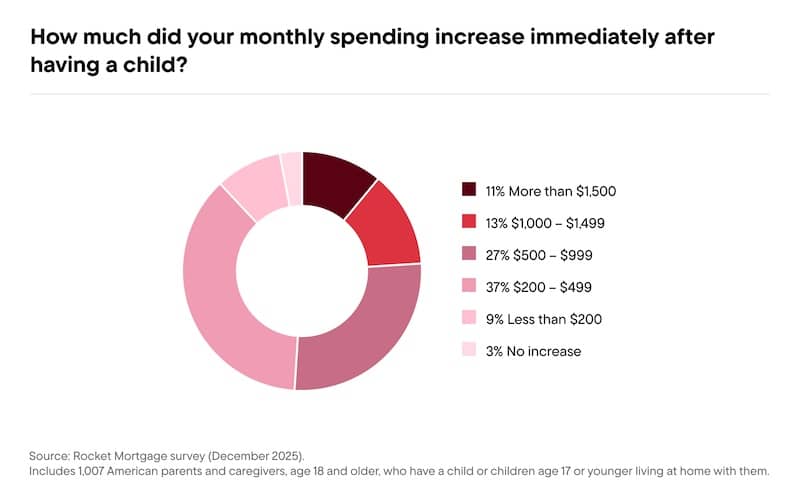
Our data reflects the demands of financial planning for the family. Nearly one-quarter (24%) of survey respondents say their monthly household spending increased by $1,000 or more immediately after having a child or children, and 27% say it increased by $500 – $999.
An additional 37% of respondents say monthly spending increased by $200 – $499, which isn’t a small increase for families on a tight budget. About 12% say their spending increased by less than $200 or not at all.
Parents and caregivers note their largest spending increases were on food and household goods, with 38% of respondents selecting this category. Another 29% say they experienced the biggest increase in spending on child care. Other categories in which respondents saw the most increases in household spending include health care (11%), education and activities (8%), housing (7%), and clothing (5%).
Families look for ways to cut back
In the face of these increased financial demands, many parents and caregivers say they’ve reduced or eliminated other expenses to free up cash. The top four areas for cost cutting among respondents to our survey were dining out and entertainment (59%), travel (54%), personal purchases (49%), and fitness classes and gym memberships (36%).
Over a quarter (26%) of survey respondents say they’ve cut back on savings and investments – a concerning development for their long-term financial goals, given the initial costs of home buying. Nearly 14% say they’ve reduced or eliminated retirement contributions after having children, too. That’s a substantial number of Americans who say that they’ve sacrificed at least some financial security to grow their family.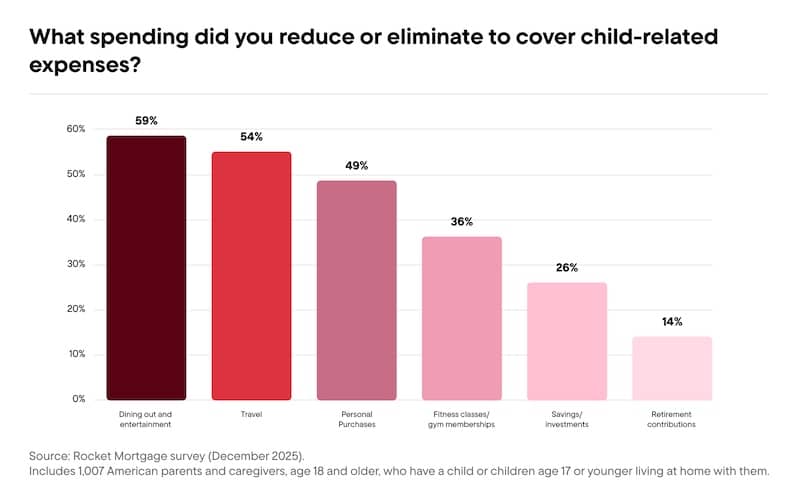
Parents focus on what kids need today – at any cost
Many parents and caregivers are willing to do whatever it takes to cover child-related expenses: 58% of respondents say they’ve gone into credit card debt or taken out loans to pay for some of these costs.
These decisions aren’t without consequences. Nearly half (46%) of survey respondents say financial concerns related to children “always” or “usually” cause stress in their households, and another 34% say they sometimes do.

In addition, 50% of respondents say they have delayed or avoided having additional children due to financial concerns, putting the American Dream of a growing family on hold.
Paychecks often go right to child care
Not surprisingly, one of the biggest costs for parents and caregivers is child care. Of our survey respondents, more than half (54%) say they pay for either full-time or part-time child care.
Within the group paying for child care, 32% say they spend between 20% – 29% of their household income on child care costs, and 27% say they spend from 30% – 39%. Another 16% say they spend between 10% – 19% of their income on child care, and 7% say they spend a whopping 50% or more.
This data tracks with Care.com’s 2026 “Cost of Care” report, which indicates that the average parent spends 20% of their yearly income on child care. The same report also shows parents juggling four different child care arrangements, on average – adding to household stress.
Of the 46% of Rocket Mortgage respondents who say they don’t pay for child care, more than half (54%) say they or their partner are a stay-at-home parent, while 20% say a grandparent primarily watches their child or children. Another 11% of this group say they rely on a free after-school program.
Parents want to give children a brighter tomorrow – and stability today
Many parents and caregivers are saving and preparing to tackle future expenses, too.
A majority (61%) of survey respondents say they’ve started saving for future education costs, and 73% of those who haven’t say they plan to do so. Only 11% of all respondents say they aren’t saving and don’t intend to.
Taken as a whole, these numbers suggest that while parents and caregivers might be struggling to meet some of the additional expenses of raising children, they remain interested in their long-term financial goals. One of these goals is owning a home.
Responses to the Rocket Mortgage survey show that caring for a child or children influences parents’ and caregivers’ attitudes toward homeownership. About 43% of respondents say that having kids has made them feel they need more space for their family, while 41% say being responsible for a child or children triggers a stronger need for stability. Another 38% say having kids makes them want a safer and better environment.
This data suggests that many families still view a stable home as an important part of the American Dream, despite the financial challenges they may face to get there.
Methodology: How do kids change the financial picture in 2026?
Rocket Mortgage surveyed 1,007 American parents and caregivers age 18 and older who have a child or children age 17 or younger living at home with them. The survey was conducted online in December 2025.
Rocket Mortgage is a trademark of Rocket Mortgage, LLC or its affiliates.

Miranda Crace
Miranda Crace is a Senior Section Editor for the Rocket Companies, bringing a wealth of knowledge about mortgages, personal finance, real estate, and personal loans for over 10 years. Miranda is dedicated to advancing financial literacy and empowering individuals to achieve their financial and homeownership goals. She graduated from Wayne State University where she studied PR Writing, Film Production, and Film Editing. Her creative talents shine through her contributions to the popular video series "Home Lore" and "The Red Desk," which were nominated for the prestigious Shorty Awards. In her spare time, Miranda enjoys traveling, actively engages in the entrepreneurial community, and savors a perfectly brewed cup of coffee.
Related resources
3-minute read
Dual income households: How kids change the financial picture
Explore the differences in earnings, retirement savings and homeownership between dual-income households with kids (DIWKs) and without kids (DINKs).
Read more

9-minute read
Raising kids in 2026: What parents really want in a hometown
When deciding where to raise a family, Americans look for safe, affordable communities to live in. See the top places in the U.S. to raise your kids in 2026....
Read more

13-minute read
The top 15 fastest-growing cities in the US
Wanting to move to a busy city with a rapidly growing population? Explore the fastest-growing cities in the U.S. and discover why people are flocking there.<...
Read more