How much does it cost to renovate a house?
Updated Jul 10, 2026
•7-minute read


A renovation project can bring new life to your home, not only boosting its value but also your enjoyment of it. But how much will a home renovation cost?
Not surprisingly, there is no simple answer. The cost of your home renovation will vary depending on the scope of the project. Adding new cabinets, countertops and appliances to your kitchen will cost more than replacing your home’s front and back doors.
It’s important, though, to at least have a baseline estimate of how much your home renovation project might cost before you hire any contractors or buy materials. In this story, we’ll look at how much you can expect to spend based on the project you are tackling.
As a note, many people use the terms “remodel” and “renovation” interchangeably. Remodels, though, typically involve larger-scale improvements such as adding a new bathroom while renovations usually focus on smaller updates such as adding new flooring to your kitchen.
Average home renovation costs
Depending on the specific project, you can expect to spend an average of $19,481 to $88,369 to renovate a house, according to a 2025 report from home services site Angi.
If you are renovating a home of 1,250 – 1,600 square feet, you can expect to spend an average of $52,228 on renovations, Angi reported.
The 2025 U.S. Houzz & Home Study found that the median amount of money that homeowners spent on renovations fell slightly in 2024. According to the study, homeowners tackling renovations in 2024 spent a median amount of $20,000. That's down $4,000 from the median spend of $24,000 in 2023.
While the figures from Angi and the Houzz study are important, the amount you spend on renovations will depend on several factors, including:
- Scope: Are you renovating your bathroom only or do you plan to upgrade your outdated kitchen, too? The more projects you take on with your renovation, the more you will spend.
- Size of your project: Renovating a small laundry room will typically cost less than renovating your kitchen or master bedroom. The more square footage you renovate, the more dollars you'll usually spend.
- Quality of the materials: Say you plan to replace your home's exterior siding. You'll spend more if you use higher-quality siding. If you use higher-quality tiles in a bathroom remodel, you'll spend more, too. Typically, using higher-quality materials will boost the cost of your renovation project.
- Current state of the home: Renovations in an older home can prove more expensive than those in a newer home. You might need to replace outdated wiring or plumbing when renovating an older home, something that you might be able to avoid in a newer residence.
See what you qualify for
House renovation cost by project
You can fund your renovation projects in a variety of ways, from using cash savings to applying for home improvement loans or turning to personal loans.
No matter how you fund these improvements, it can be challenging to keep a home renovation project on budget. Just look at the 2025 U.S. Houzz & Home Study: The study found that 26% of survey respondents said that they struggled to stay on budget during their renovation project. A total of 19% of respondents said they struggled to stay on schedule.
This underscores just how important it is to set a budget when tackling a renovation project. If you don’t, it’s easy to spend far more than you planned on your project.
To help, here is a list of common home renovation projects and the median amount of money you can expect to spend on them. The numbers below come from several sources, including Angi, Fixr and HomeAdvisor.
Gut renovation
Maybe you have big plans for your home and you’re ready to tackle a gut renovation, stripping your home’s interior to its basic structural elements. Be prepared to spend: This ranks as the most expensive type of home renovation, though it remains less expensive than demolishing a home and building a new one from scratch.
First, start with gutting the house. HomeAdvisor says that the cost to gut a house in 2025 ranged from $1,100 to $5,100, with the average homeowner spending $3,000. What you spend, though, will depend on the size of your home, the cost of labor in your area and the difficulty of the work.
HomeAdvisor says that in 2025 it costs from $2 to $8 a square foot to gut a home. Owners of a 1,000-square-foot home, then, can expect to spend from $2,000 to $8,000 to gut their property. Those with a 2,000-square-foot home can expect to spend from $4,000 to $16,000. And those with a 5,000-square-foot home would spend from $10,000 to $40,000 just on gutting the property.
The cost of renovating a home after it’s gutted varies, too, but HomeAdvisor said that in 2025 a home renovation costs from $19,481 to $88,369, with homeowners spending an average of $52,228 or $15 – $60 a square foot.
These costs will vary, again, depending on the size of the home and the scope of the work. HomeAdvisor said that in 2025 it cost from $18,750 to $75,000 to renovate a 1,250-square-foot home, $37,500 to $150,000 for a 2,500-square-foot home and $52,500 to $210,000 for a 3,500-square-foot home.
Interior demolition
The first step in many renovation projects is interior demolition. Say you are remodeling your bathroom. You might need to first remove existing walls, tear out appliances and rip out flooring.
How much this will cost will vary by the size of the room, but HomeAdvisor says that in 2025, it generally cost from $1,065 to $5,054 to demolish an interior. This comes out to $2 – $7 a square foot on average. This price typically includes the removal of debris, permits, dumping fees, and labor costs.
Bedroom renovation
Want to convert your small bedroom into a primary bedroom with a walk-in closet? Expect a sizable price tag. Angi reported in 2025 that a bedroom remodel cost from $12,000 to $28,000, with the average homeowner spending $20,000. Angi said that the size of the bedroom, the flooring that you choose and any additional features that you include in the project will impact the amount you spend.
Size, though, is the key factor. Angi said that the average remodeling cost for an 80-square-foot bedroom ranges from $7,800 to $11,300, while that figure rises to $19,400 – $25,100 for a 170-square-foot bedroom.
Bathroom renovation
Bathrooms are a popular target for remodeling, with many homeowners seeking to transform these spaces into peaceful oases. Angi reported that in 2025, a bathroom remodel cost from $6,639 to $17,620, with the average homeowner spending $12,122.
Angi said that you can expect to pay more if you choose high-end materials or change your bathroom layout, with a high-end luxury remodel costing $80,000 or more.
Kitchen renovation
Another popular choice for renovations is a home's kitchen, not surprising given how much time families spend in them. Angi said that a kitchen renovation cost from $14,585 to $41,530 in 2025. The average homeowner spends $26,968.
Overall, you should expect to spend from $75 to $250 a square foot on a kitchen remodel, according to Angi. Minor kitchen remodels might cost $10,000 – $20,000, while major kitchen projects might cost you $65,000 – $130,000.
Angi said that cabinets, flooring, and countertops account for nearly 75% of kitchen remodel costs.
Garage renovation
Renovating your garage can cost from $7,000 to $30,000, according to Angi, with the average renovation running $18,000. Angi said that applying for permits can be one of the costlier parts of a garage remodel, especially if you’re changing the purpose of the space. Labor and electrical costs will also play a key role in your final bill.
Take the first step toward the right mortgage
Apply online for expert recommendations with real interest rates and payments
Home exterior renovation
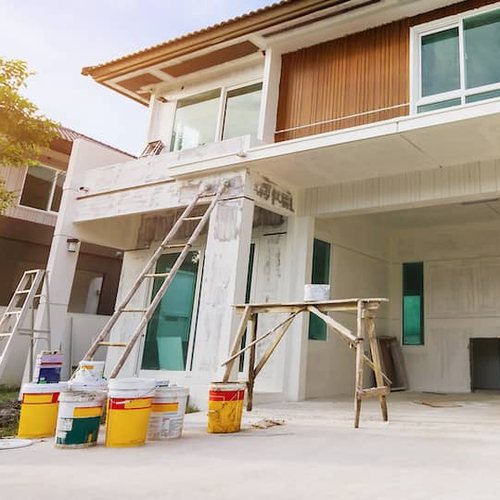
Exterior renovations can boost the curb appeal of your home, increase your property’s energy efficiency or protect your residence from rain or wind. And as with interior work, these renovations can run the gamut from simple, such as painting a front door or adding a railing to your deck, to major projects, such as replacing a roof or installing new windows.
Here’s a look at how much you can expect to pay for the most common exterior home renovations.
Roof replacement
Replacing a roof is not a cheap fix. According to Fixr, a roof replacement in 2025 cost from $7,500 to $14,000, with homeowners spending an average of $10,000 for this job.
You might be able to reduce this cost by repairing a roof rather than replacing it. Repairs are typically less expensive, though this will depend on the condition of your roof. It’s best to ask a professional roofer to help determine whether replacing or repairing it is the better choice.
Siding replacement
Replacing old siding can boost the curb appeal and value of your home. But this benefit doesn't come cheap: Fixr reports that it costs an average of $6,000 to $18,000 to replace a home's siding. How much you spend will depend on how large your home is, with Fixr saying that new siding costs an average of $4.25 to $16.50 a square foot.
Again, you might save money by repairing your home’s siding rather than replacing it. This depends on the condition of this siding.
Deck replacement
Replacing an old deck might be a smart investment if you enjoy spending time outside. How much this will cost depends on the size of your new deck and the materials that you use. But Fixr says that it costs homeowners an average of $9,000 – $20,000 to build a new deck.
Homeowners pay an average of $14,000 to build a 320-square-foot deck made with composite decking materials and railings, according to Fixr's research. Overall, homeowners spend an average of $15 – $55 a square foot to build a deck, Fixr said.
Entryway addition
Hiring a contractor to build a new entryway can give your home extra square footage while also improving its functionality and visual appeal. An entryway can also boost your home’s value when it’s time to sell.
Angi says that you can expect to pay from $14,000 to $32,000 on an entryway addition, with homeowners paying an average of $18,000 for this renovation. How much you pay depends on the entryway’s size, the materials you choose and the complexity of the project.
Need extra cash for home improvement?
Use your home equity for a cash-out refinance
Home renovation cost estimator spreadsheet
The final cost of your home renovations will be unique to your home, your circumstances, and your preferences. Follow these instructions to get the most out of the free cost estimator spreadsheet and create a realistic remodeling budget.
- Make a copy of the spreadsheet so you can edit it for your projects.
- Set a budget line item for each project.
- Collect estimates from vendors.
- Fill in the costs for each project, such as inspections, designs, and permits.
- Plug each project’s actual cost into column E.
- Periodically revisit the spreadsheet to adjust your costs and budget.
The bottom line: Home renovation costs will vary
Renovating a home can boost the value of your residence and increase your enjoyment of it. But it’s important to know how much your renovation might cost. Renovation costs vary by the scope and size of a project, your area’s labor costs and the type of materials that you use. Make sure that you are prepared for the possible costs of your project before you financially commit to a home renovation.
And if you want to tap the equity in your home to help pay for a renovation, you can apply for a Home Equity Loan1 from Rocket Mortgage2 today.
1Home Equity Loan Product is a second standalone lien and may not be used for piggyback transactions. Valid for loan amounts between $45,000.00 and $500,000.00 (minimum loan amount for properties located in Michigan is $10,000.00). Not available on Ameriprise products. Additional restrictions, terms, and conditions apply. Must meet qualification requirements. This is not a commitment to lend.
2 Rocket and Official Mortgage Review are trademarks of Rocket Mortgage, LLC or its affiliates.

Dan Rafter
Dan Rafter has been writing about personal finance for more than 15 years. He's written for publications ranging from the Chicago Tribune and Washington Post to Wise Bread, RocketMortgage.com and RocketHQ.com.
Related resources

7-minute read
Using a home equity loan for your remodel: What to know
Thinking about a home remodel? If you have enough equity, a home equity loan could help you pay for it. Learn the benefits, risks, and tips for using one.
Read more
10-minute read
Home improvement grants to fund your next repair project
If you’re looking for help with home repairs, some homeowners might be eligible for grants that can fund key renovations – and don’t need to b...
Read more

9-minute read
What is home equity? A complete guide for homeowners
Home equity is the portion of your home you own. Learn how home equity works, how to calculate it, and common ways homeowners can leverage their equity.
Read more